
Pruning

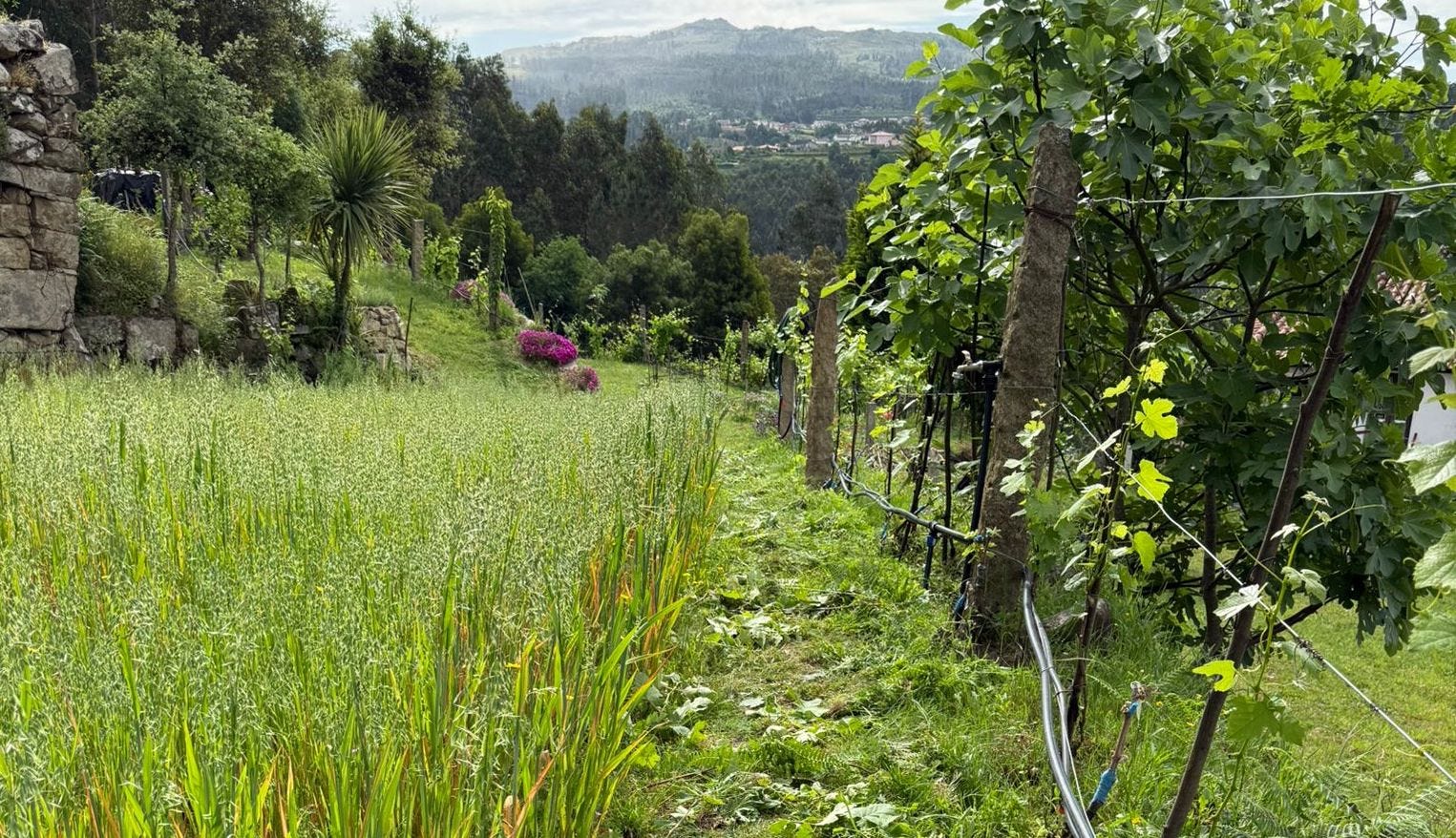
For the last couple of days I’ve taken matters into my own hands, literally. My farm helper has been busy elsewhere. I took the opportunity to ask my good friend, who built a small but now globally recognized vineyard from nothing just seven years ago, largely on her own, about my vines and whether they needed pruning now. She often has her three-year-old daughter with her, moving between rows and responsibilities with a kind of quiet determination that I admire. We have a mutual admiration for each other. I’m a couple of decades older, an extrovert; she’s more introverted, sometimes socially anxious despite her beauty, style, and the warmth she has learned to lead with. We often co-host food and wine events together, her wine, my food, and I find myself wanting, on a much smaller scale, to follow what she has built.
My vines are so bushy. The record-breaking rains here this winter turbocharged everything, the vines, the weeds, and the dreaded mimosa that becomes fuel in fire season. And fires have already started popping up, earlier than usual. I can’t cut the mimosas down. But I imagined that if my s’hero winemaker can manage her vines and be part of each step, I should be able to follow her lead.
It’s the second year for about 650 vines, and 5 months in for another 100 new alvarinho. I have alvarinho and chardonnay as whites, and syrah and touriga nacional for reds. I plan to bottle them up as blends to create a mini boutique winery, if I succeed. It is a big IF. I don’t know anything about vines. Nothing. I bought this land and there had been vines here for hundreds of years, but most were gone. Before I started anything I cleared the overgrown land and created some ramps to make sure each level of the land was accessible by some kind of motorized vehicle. When I got here I’d just had my cast taken off for a double break in my humerus. I have had several bike or scooter falls over the last 10 years and wanted to make sure that in the worst case I could access all of the terraces and fields here. I loved watching the big digger make the new “roads” and move the giant stones to shore up some of the walls.
Growing grapes, and then hopefully producing wine, takes a kind of patience I don’t have a lot of. It took a lot of vision to see beyond the brambles and abandoned fields, the house that hadn’t been lived in for 30 years. But planting something with delayed rewards... I was in a hurry to get them in. It took 4 days and 3 other people to dig the holes and plant them. Before that I used Google Earth and ChatGPT to figure out what grapes would thrive in my micro-climate, with all of the granite, on a south facing hill. AI has been my constant companion since I got here about 20 months ago. And more than ever the last few days.
My farm helper nearly quit when I told him I would prune the vines, and that I’d had the advice of my successful winemaker friend. He lives about 200 meters from me and his family has been in the area for generations. Of course they all have grown grapes and made wine. But he didn’t have the experience of a large and successful winery owner. He is also a man, in a man’s world and doesn’t like to be told how to do anything by any woman. Little does he know that all of my instructions to him, like the kind of sprays we use on the vines to maintain their organic nature, while preparing for certification, come from AI. I just go out and buy what’s needed and show him where it is.
I nearly cried last year when he pruned the new vines. They were so beautiful and I had hoped that my summer guests would see them in all of their glory. But he cut them back to almost nothing. I hadn’t had my AI coaching about pruning at that point. I didn’t know that, like teaching your kid to cross the street, means doing something hard for the best reasons. I didn’t know anything at all about the vines, other than the varieties, how far apart to plant them, and what to put in the hole while planting. Pruning, like patience, is something that is hard for me in so many areas of my life. In business I get carried away with all of the wonderful things I can do with technology, all of the situations where my software can help. With my vines all I can think of is how beautiful they are now.
So I got my clippers, my gloves and my little red stool and went out with my phone in hand. My friend showed me what the goal was with one vine. I wish she had stayed and done a few cuts with me, but she was just visiting for my birthday lunch. I was on my own. The goal is to have either a single guyot or a double guyot, I didn’t know the difference between them or even what a guyot was before I sat down on this stool. I learned to follow the trunk up to the first wire and remove everything below, sparing one main vine, the straightest one going up, and finding another that creates a V near that wire. Everything else had to go below the wire. This was painful. I had to throw away branches that are full of little tiny bunches of grapes, my future bottles of wine.
I took photo after photo, of the same vine, asking the AI whether I was doing it right, which cane to keep, and on and on. He estimated I could do one vine every minute. That sounded good, but it turned out to be impossible. Too many questions and too little cutting. On the first day I managed 60, only 690 to go. And about the same the second morning. I am sure I will get faster. I am absolutely learning about letting go, and how losing the extra leaves will pay off later. It’s a little loss for a lot of gain.
As I walked down the path along a row of touriga nacional on one side and my 100 square meters of oats on the other side, I felt the glow of self-satisfaction, self-sufficiency. I felt the joy of doing even with such imperfection. Taking things into my own hands has had incredible repercussions. Learning to do so many new things in such a short amount of time, becoming a farmer as my side hustle has given me a new kind of confidence, grounding my intellect in the dirt, stripping off the noise and excess like I stripped off the grape leaves.
What surprised me most is that pruning is not just about the vines. It is about structure. Left alone, everything grows, expands, reaches for more light, more space, more possibility. It looks like abundance. It feels like progress. But without structure, it becomes something else entirely. Too many shoots, too many leaves, too many directions, and none of them strong enough to carry what comes next.
I recognize that pattern. In my work, in the way I think about building systems, it is easy to keep adding, more features, more use cases, more possibilities. It all looks like growth. But it creates fragility. Too many dependencies, too many assumptions, too many things that have to hold at once. And then when pressure comes, something breaks, not because there was too little, but because there was too much.
Pruning feels like loss when you are doing it. It looks like you are cutting away the very thing you were hoping to create. But what you are actually doing is choosing where strength will go. Deciding what matters. Creating the conditions for something that can hold.
I am still slow. Still unsure. Still asking AI too many questions. But I am starting to understand that the work is not just in growing. It is in cutting back, in shaping, in removing what looks valuable so that something real can emerge.
It turns out that resilience is not just about building more. Sometimes it is about having the discipline to cut things away.
And like the vines, I am learning, slowly, where to make those cuts.